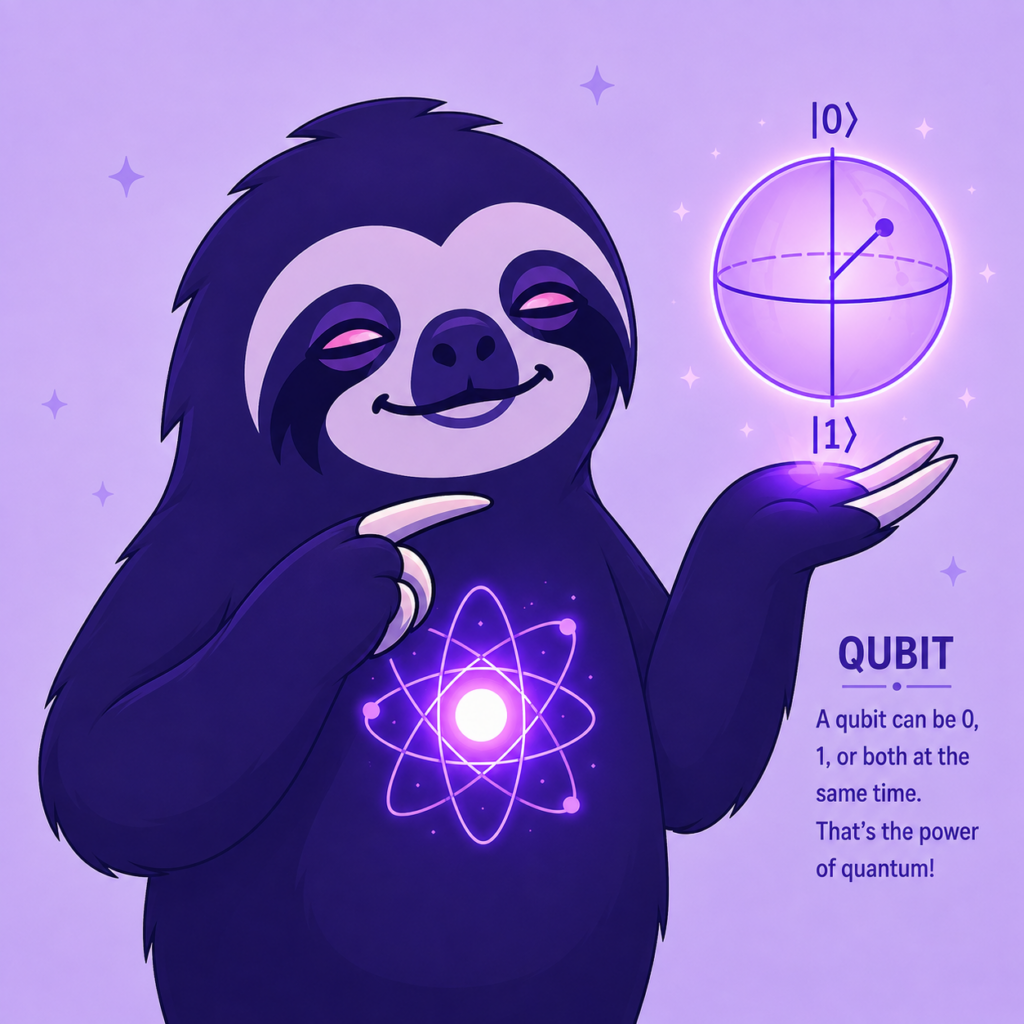
What is a qubit simplified
Qubits are the foundational unit of information for a quantum computer. Unlike a classical bit, which is strictly either 0 or 1, qubits can exist in 0, 1, or anywhere in between. The 0 and the 1 in qubits are considered basis states. Superpositions allow qubits to represent values between 0 and 1 until they are measured. Without Superposition, quantum computers would not be able to do the interesting calculations they strive to compute with.
Important Key Concepts
This is where qubits start seeming confusing and difficult to understand for the average person. Diving in deeper into qubit research, you will find they operate by the probability of what state the qubits are currently in. A few concepts to learn are basis states, superposition, state vectors, bloch spheres, and quantum gates.
Key Concept 1: Basis States
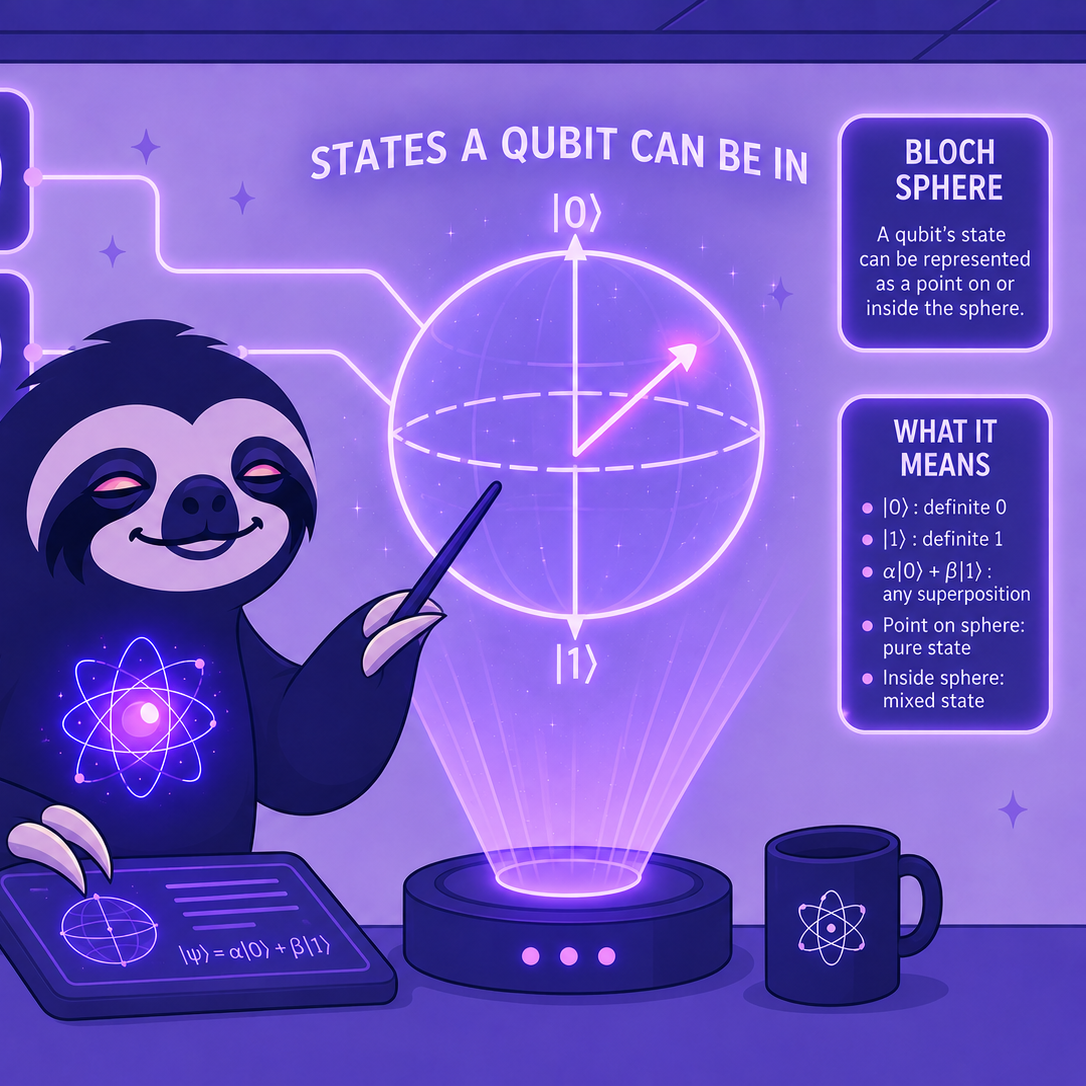
All qubits have what is called the “North pole,” which usually represents 0, and the “South pole,” which represents 1. These become the basis states!
Key Concept 2: Superposition & State Vectors
Superposition is essentially the possibility of a qubit being both 1 and 0 at the same time; the state vector will allow you to read and figure out how much of 1 or 0 the qubit’s state is in. For example, the state vector could show a 70% chance towards 1 and a 30% chance towards 0. A simple way to understand state vectors: imagine a magical arrow from the center of a sphere. If it points straight up. It’s for sure at 0 basis state; if it points straight down, it’s at a 1 basis state; however, if that arrow points somewhere in between, you know it’s in a superposition state. A state vector essentially points to where in superposition the state of the qubit likely is.
For a more compact definition: A state vector is the representation of the likelihood of various outcomes when measuring a quantum system. This essentially determines the superposition of the qubit.
Key Concept 3: Bloch Spheres
Bloch spheres are a 3d representation of whether a qubit is going to collapse into any superposition. Quantum computers utilize vectors to determine where on the surface of the Bloch sphere the qubit is.
Key Concept 4: Quantum Gates
The concept of quantum gates is where qubits start getting more applicable to building circuits and use cases in the engineering of quantum computers. There are many different gate designs that are used but they essentially allow programmers to change the state the qubit is in.
Below are two steps that show the life of a qubit being manipulated by a quantum gate operation.
1. The gate take the state of a qubit (state of the qubit being the amplitudes associated with 1 and 0, and probability of it being 1 or 0)
2. The gate transforms the current state into another state.
Additionally, gates also have to be applied physically with hardware, not just with equations, and it’s done on real qubits—this is done through microwave control pulses, lasers, or optical components depending on the hardware in use.
Next Learning Steps
Now that you have a basic introduction to these 4 concepts above, if you want to learn more; a list of resources can be found at the bottom of this page that was referenced while gathering research for this page; they are good resources to dive into more specific applications of the generalized topics above.
Additionally, for more simple concepts in quantum computing, check out the other subtopics on the quantum computing learning roadmap!
Questions & Answers Regarding Qubits
How does superposition work?
Superposition is a quantum mechanics observation that can be applied to qubits. The qubits are in superposition when they are not definitively pointing towards 1 or 0. They are in superposition when they are both at the same time until their state is observed.
What makes using qubits better than bits?
They are not inherently better or worse than each other. They are both better at what they are designed to do, linear & sequential computing for bits and complex computation for qubits. When the work that needs to be done requires multiple processes computed in unison or parallel, that is the use case for a qubit. That said, the superposition concept and state space concept qubits operate with seem to be the key benefit for using a qubit specifically. Due to the concept of state space, multiple qubits stacked together grow exponentially in power and allow for computation of a problem all at once with all the qubits in play working in parallel instead of the linear restriction of computing with multiple normal bits one by one.
How many qubits make up a working computer?
For a functional good quantum computer, simply 10 logical qubits would be an impressive amount in my books. As of 2026, no quantum computer is capable of this yet.
How will qubits be used now & in the future?
Solutions for quantum computing seem to be looking to use logical qubits on top of physical qubits to get the best bang for their buck. Mostly gate-based and annealing-based systems have been studied & used until recently. Additionally, underneath the scope of the gate-based approach, there are some individual approaches for building the qubits! Now there are currently innovations like the photon-based qubit systems. Some solutions use neutral atoms… Some use trapped ions to make up the qubits. All of these approaches have complex benefits and use cases. That said. Every leader in the quantum computing space has different solutions to utilize qubits, so the final answer is simply saying they will be used in a lot of very different complex ways…